
I recently came across a fascinating piece of news:
John G. Cramer, a 90-year-old physicist, has volunteered for a cutting-edge longevity trial involving bioreactor-grown mitochondria, developed by biotech startup Mitrix Bio.
🎧 Podcasts generated by NotebookLM:
🎧 Listen to “Mitochondria May Be the Master Switch for Aging”
🎧 Listen to “노화의_마스터 스위치, 미토콘드리아! 당신의 세포 운명을 바꿀 비밀”
A 90-Year-Old Quantum Physicist Just Joined an Anti-Aging Trial to challenge age limits

At first glance, it may sound like a human-interest story about an elderly man chasing youth. But he brings to this experiment a scientist’s precision and courage. He stated:
“I’ve analyzed the longevity treatments, and mitochondrial transplantation is the first that seems potentially safe and powerful enough to get someone past 122 in good health.”
Cramer is turning his body into a living hypothesis, guided by scientific rigor and a desire to push the frontier of human aging. His leap into the unknown may well reshape what we believe is possible.
Mitocondria Rejuvenation
Mitrix Bio was founded with the bold mission of reversing aging by restoring mitochondrial function at scale. Based in California, the company is pioneering the use of lab-grown, autologous mitochondria as a therapeutic modality – not just for rare mitochondrial diseases, but for age-related degeneration across multiple organ systems.
Sound familiar? That’s because we featured Mitrix Bio in our Longevity Talk interview series with Ronjon Nag, who mentioned the company while introducing his investment portfolio.
Mitochondrial Dysfunction as a Core Hallmark of Aging

Mitochondria, often described as the ‘power plants’ of cells, are known to decline in both number and function with age.
As early as the 1940s and 50s, researchers began proposing that a decline in mitochondrial function might be a driving force behind the aging process. Over the decades, this hypothesis has gained growing support, with mounting evidence linking mitochondrial dysfunction to nearly every hallmark of aging and many chronic diseases.

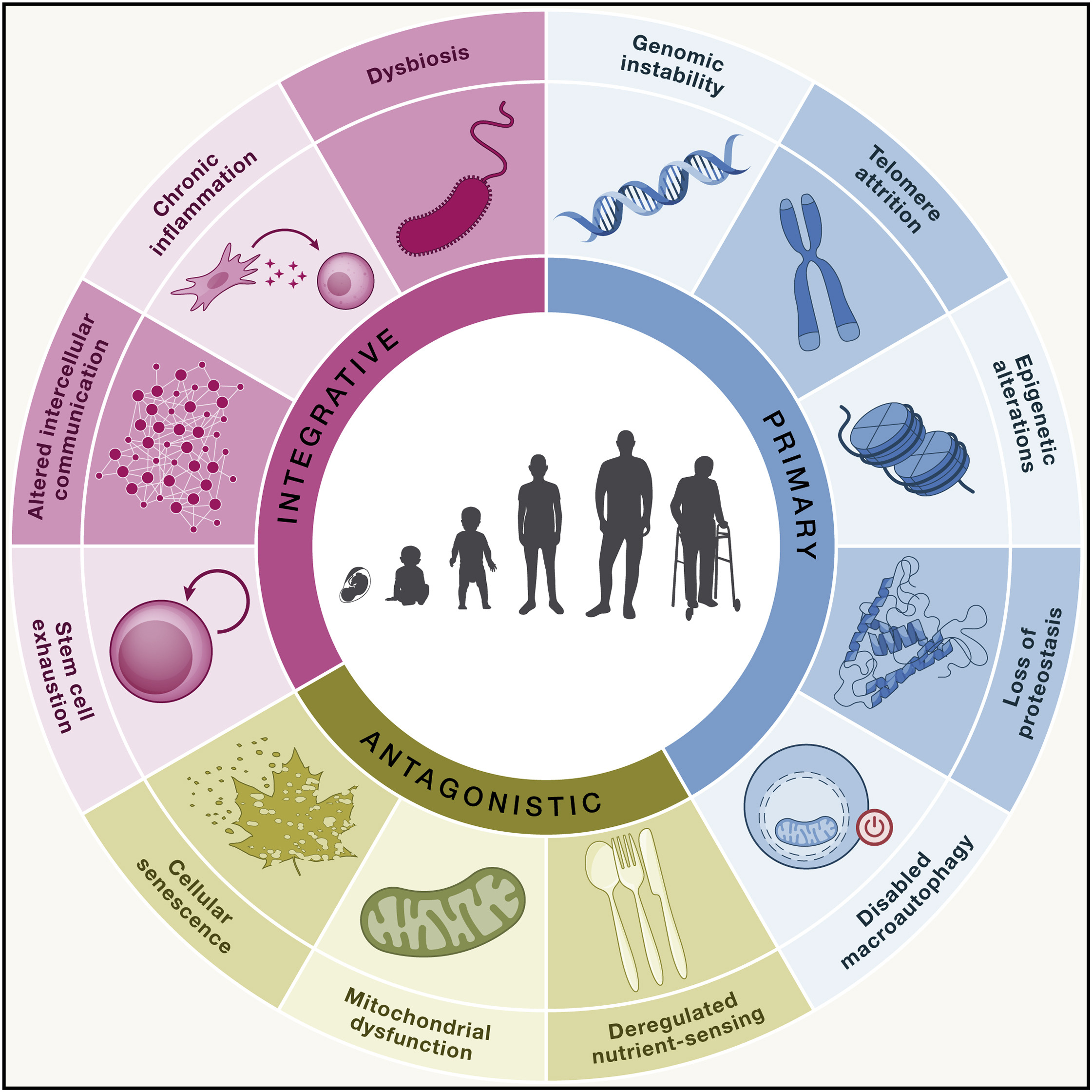
2003 2013
The landmark 2013 paper “The Hallmarks of Aging” by López-Otín et al. identified mitochondrial dysfunction as one of the nine fundamental causes of aging. In the updated 2023 version, “The Hallmarks of Aging: An Expanding Universe”, the list expanded to twelve hallmarks including mitochondrial dysfunction.
Mitochondria are more than just energy producers (ATP).They are crucial for:
• Trigger cell self-destruction: Help clear out damaged cells before they cause harm.
• Balance calcium: Regulate cellular calcium, vital for muscles and nerves.
• Regulate immunity and inflammation: Influence how your immune system responds.
• Produce ROS: Reactive oxygen species help signaling in small amounts, but too much causes damage to DNA and proteins.
As We Age…
Mitochondria become dysfunctional, leading to a cascade of problems:
• Leak energy, producing harmful byproducts (oxidative stress).
• Lose their power, reducing ATP and cell function.
• Pile up as damaged organelles, because cleanup systems slow down.
• Mutate, creating a feedback loop of dysfunction and inflammation.
It’s a core breakdown of cellular vitality.
Mitochondrial dysfunction has been strongly implicated in a wide range of age-related diseases:
• Neurological disorders: Nerve cells, with high energy demands, are especially vulnerable. Mitochondrial decline contributes to diseases like Alzheimer’s, Parkinson’s, and ALS.
• Cardiovascular issues: The heart is the most mitochondria-dense organ. Impaired mitochondrial function weakens heart muscle cells, contributing to heart failure.
• Metabolic conditions: Mitochondrial aging is linked to insulin resistance, type 2 diabetes, and obesity.
• Sensory decline: Age-related hearing loss and vision impairment have both been tied to mitochondrial deterioration.
In short, mitochondrial dysfunction may be the unifying thread connecting many of the conditions we associate with getting older.
Mitochondria Transfer Research

by Mitrix
While still unapproved and untested in large-scale human trials, mitochondrial transplantation has shown early promise in animal models and specific clinical settings.
For example, parkinson’s disease, age-related macular degeneration (AMD), and sarcopenia with animal models. Northwell Health has explored its potential in acute conditions including cardiac arrest and stroke. The team conducted a limited pilot study on infants with severe complications after heart surgery. While the study was small and focused on safety, the positive early results have encouraged further research.
Aging – A Energetic & Immunological Issue

My deeper interest in mitochondria began when I attended a seminar by a cardiothoracic surgeon from Stanford. The session profoundly shifted how I understood aging.
Among the advances he shared in cancer immunotherapy research, the part that truly captured my attention was the concept of T cell exhaustion – a key reason why even the most targeted therapies sometimes fail to work.
“Why do so many cancer patients fail to respond to immunotherapy – even when the target is right, and the drug should work?”
The answer wasn’t about drug failure, but energy failure.
He explained that T cells, our most powerful immune defenders, require high mitochondrial fitness to function. In aging or metabolically stressed individuals, those cells are often too exhausted to act – unable to sustain energy production, migration, or cell-killing ability.
That insight reframed aging in my mind as a fundamentally energetic and immunological issue, with mitochondria at the center.
Later, I came across a groundbreaking study published in Nature in 2024 that confirmed the significance of this link. It revealed that cancer cells can actively hijack mitochondria from T cells, further draining their energy and blunting the immune response.
If the immune system doesn’t have the energy to fight, it won’t, no matter how smart the drug is. Restoring mitochondrial health is about reactivating the body’s most essential defenses.
While some cancer cells exploit this mitochondrial swapping for their own survival, the process may also serve as a healing mechanism in other contexts. Scientists are now actively investigating why these exchanges occur and how we might harness them to promote recovery and resilience.
If He’s Betting His Life on Mitochondria…What Can We Do?
We may not be in a clinical trial, but we can still support our mitochondria – or at least stop hurting them?
Everyday Habits That Undermine Mitochondria.
• Chronic stress: Cortisol suppresses mitochondrial renewal and increases damage.
• Lack of exercise: Without movement, your body stops producing new mitochondria.
• Overeating, processed food: Fuel overload generates excess ROS inside cells.
• Sleep deprivation: Mitochondria repair mostly during deep sleep
• Toxins, smoking, alcohol: These poison mitochondria and block cleanup systems.
• Glucose spikes: Blood sugar overload stresses mitochondria and speeds aging.
Ways to Strengthen Mitochondria
• HIIT (High-Intensity Interval Training): Activates AMPK and PGC-1α to create new mitochondria and improve energy use. (link)
• Consistent deep sleep: Essential for mitochondrial maintenance and DNA repair (link)
• Intermittent fasting: Promotes mitophagy (removal of old/damaged mitochondria). (link)
• Cold exposure: Brief cold boosts mitochondrial efficiency and resilience. (link)
• NAD⁺ boosters (link) and polyphenols (link), etc.
Our body is a complex system – and the more we learn about it, the more we realize how much we still don’t know. One action can trigger dozens of cascading effects.
That’s why foundational habits like nutritious eating, high-quality sleep, regular movement, and balanced stress – while they may sound basic – are actually powerful. As we understand more about the body’s interconnected systems, we begin to see the compounding impact of getting the basics right.
And how well we manage those basics? It can literally determine the rate at which we age, person by person.
The EON app was designed around this principle of systemic interconnectedness. It’s a science-based tool that helps you track and manage the metrics that matter most in aging – from biomarkers and longevity’s six key pillars to critical rhythms like sleep and meal timing.
More importantly, it helps you understand the complex relationships between them, so you can make smarter decisions for your long-term health.
 Kyunivers
Leave a reply to puppyrad7ca0a3f2be Cancel reply