

Every time I read about the race to develop super intelligence, it feels familiar.
Because we’ve imagined it forever.
Timeless Desires, Modern Code

From gods to kings, prophets to ideologies.
Human history is full of attempts to build something greater than ourselves, something that could coordinate all the complexity, deliver justice, and restore order.
And now we’re doing it again.
Only this time, with code.
The real challenge lies not in constructing an AI with god-like capabilities, but in integrating such a system into our messy, profoundly human structures. We live inside complex adaptive systems – where one change ripples across time, layers, and context.
The Nature of Complexity
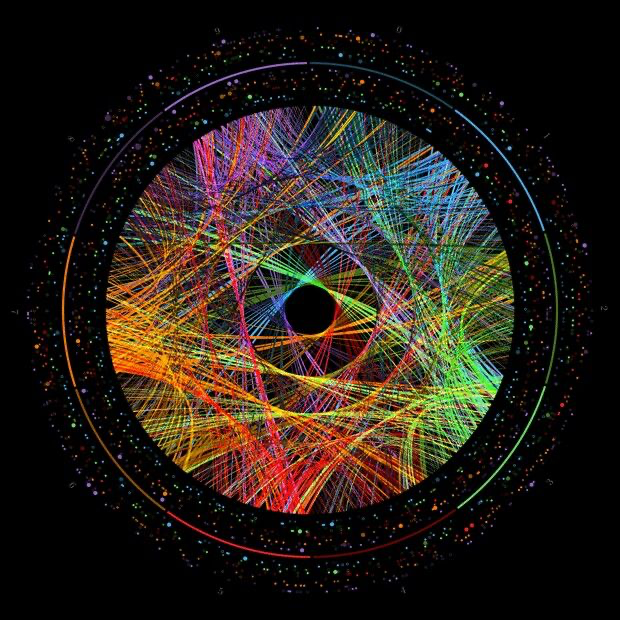
Biologists understand this phenomenon intimately: a minor cellular adjustment can trigger a cascade of unpredictable effects across tissues, hormones, and behavior. The human body is not a static machine but a living, evolving ecosystem.
This echoes a worldview long held by disciplines focused on humans, such as philosophy, religion, economics, and politics.. Throughout history, humanity has grappled with the challenge of living well in a world that lacks perfect order.
Only recently, in modern history, have we begun to grasp that the dream of a perfectly planned and coordinated utopia, as envisioned in idealized forms of communism, rarely survives contact with reality.
Despite this understanding, we persistently attempt to govern this inherent complexity with rigid ideologies or single-source “super intelligences.”
What About Healthcare?

As we’ve previously discussed, the core challenges of our time, such as chronic disease, aging, and prevention, are fundamentally rooted in systems biology.
Despite this, much of our current healthcare system still relies on outdated methods, like randomized controlled trials focused on average populations.
This disconnect isn’t accidental; it’s a structural byproduct of the pharmaceutical industry’s high-risk, blockbuster-dependent innovation model. The industry’s survival often depends on developing one-size-fits-all drugs that can scale, even when the real needs are individualized, proactive, and adaptive.
To truly harness the potential of super intelligent systems, especially in health, we need more than just intelligence. We need coordination – systems capable of transforming that intelligence into meaningful, personalized insights.
That’s exactly why we founded EON.HEALTH.
Rewiring the System

Because to truly disrupt an outdated system, we can’t simply persuade existing players or tweak their processes. Real change demands a new incentive structure – one that rewires the system itself.
When I speak with physicians, a common reflection I hear is: “People already know what’s good for them – but they rarely change behavior.”This, many say, is what makes healthcare so hard.
But here’s the paradox.
We already spend enormous time and money on beauty, youth, and vitality. And as our societies age, this investment is only growing. Beauty, at its core, is health. Peak performance is health. Happiness is health.
Being disease-free is not the goal. For years, we’ve focused on replacing doctors with digital tools under the banner of ‘digital therapeutics’ – but with limited success. Why? Because the problem was never just clinical automation or digitization. It was a flawed definition of the problem itself.
The goal is to live fully-performing at our best, looking and feeling alive.
If people can clearly envision that future – and if they have an intelligence that helps them navigate that path – then something changes.
What’s Happening Right Now – And Why It Matters to You
Over the past 20 years, we’ve seen tremendous scientific progress. In just the past few years, that pace has accelerated, driven by global applications of mRNA vaccines, breakthroughs like AlphaFold in biology, and growing public acceptance of preventive medicine through innovations like GLP-1.
If you could confidently expect to live healthily to 120, wouldn’t that change the way you make major life decisions – your education, career, marriage, and family planning?
And if you knew that today, wouldn’t it change how you live today?
That’s why EON shares this newsletter and our Longevity Talkinterview series—to help more people understand what’s happening at the cutting edge of science and what it means for our future.
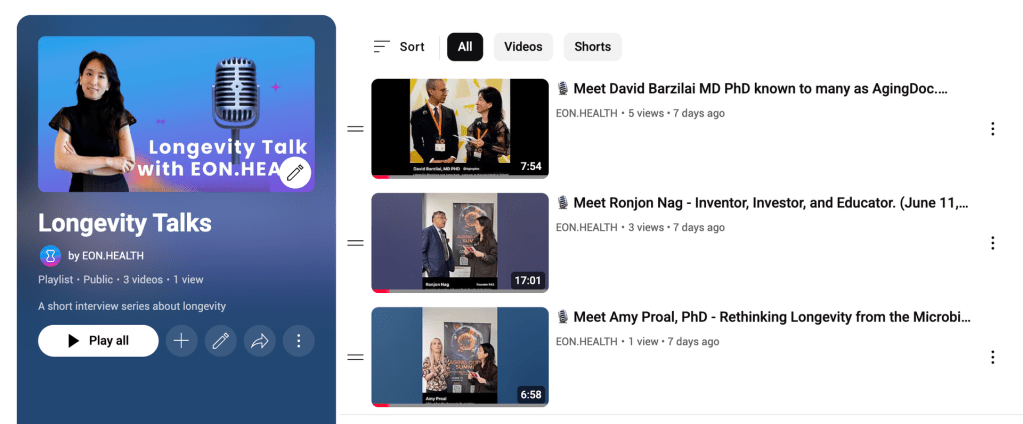
We’re sharing these Longevity Talk interviews on our EON LinkedIn, YouTube, and Instagram channels. Stay tuned!
From Vision to Platform
The EON App is the foundational first step in our larger platform vision, and we are eager to accelerate to what’s next.
We are preparing many features to bring to life and can’t wait to share them with you soon.
We are entering an age where the marginal cost of producing value is rapidly approaching zero. In a world shaped by AI and robotics, the true battleground is shifting to energy and resource dominance – a transformation already visible worldwide.
As “what” and “how” become increasingly easy, “why” becomes everything. For startups, this means philosophy matters more than ever.
This is why we’re hosting this webinar on August 6 titled:
“Not One AI, But Millions: How EON Is Designing Health Intelligence.”
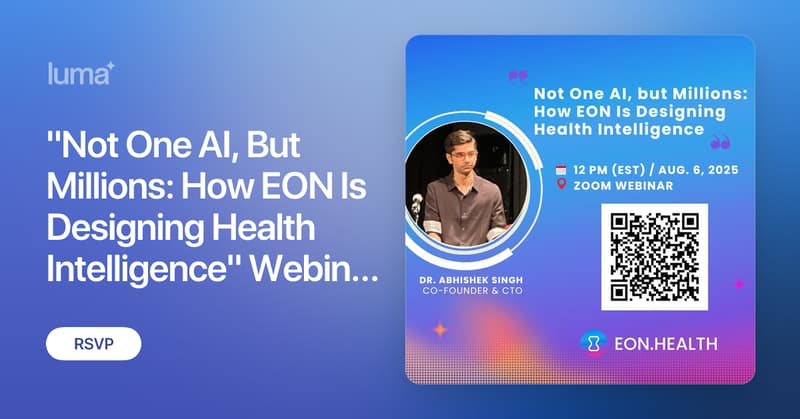
We’ll share how we’re implementing these concepts, starting with the CHAOS framework. This framework, a revolutionary approach to coordinated health intelligence, was developed by my co-founder Dr. Abhishek Singh and recently gained recognition in Forbes.
We’ll also introduce what we’re building at EON to make preventive, personalized, and adaptive health intelligence truly actionable at the individual level, at scale.
True support for human health and society requires acknowledging, rather than avoiding, life’s inherent chaos. It means embracing life’s ever-changing nature and designing adaptable intelligence.
Instead of a single, all-powerful machine, we need millions of intelligent systems that mirror our own complexities, along with tools to foster self-understanding, proactive adaptation, and informed decision-making.
 Kyunivers
Leave a comment