

Now that EON is officially open to the public, we’re shifting gears.
Until recently, we kept things separate – sharing macro foresight (science, tech, trends, and longevity insights) here in the newsletter, and delivering micro-level, actionable insight to our beta testers. But it’s clear now: many of you want both. So starting today, we’re blending the two.
This edition is an expanded version of what we first shared with EON beta testers back in Mar. 11. It covers one of the most powerful (but often overlooked) signals of your health: Resting Heart Rate (RHR).
We’ll walk you through:
• Why RHR matters for health and longevity
• How to improve it using lifestyle fundamentals
• And how EON can help uncover what’s truly affecting yourRHR
Let’s get into it.
🎧 Podcasts generated by NotebookLM:
🎧 Listen to “Unlocking the Secrets of YOUR Longevity – 🫀 RHR”
🎧 Listen to “건강 장수의 비밀 – RHR (Resting Heart Rate)”
What Animals Can Teach Us About Heart Rate. The Secret to Longevity?
Imagine a creature that lives for over 200 years.
The bowhead whale, one of Earth’s longest-living mammals, has a heart rate as low as 10-15 bpm(beats per minute).
Similarly, the Galápagos tortoise, which can surpass average 100 years of life, has a heart rate as slow as 6 bpm.

These animals’ long lifespans have intrigued scientists for decades, leading to an interesting hypothesis:
Could heart rate and longevity be connected?
Some researchers suggest that total heartbeats over a lifetime may influence lifespan. Compare that to mice, whose hearts race at 400-600 bpm and who typically live only a couple of years. 🤔
Why Does Resting Heart Rate Matter?
- Your Resting Heart Rate (RHR) is one of the simplest yet most powerful indicators of overall health.
- A lower RHR often signals a stronger, more efficient heart, while a higher RHR can indicate stress, poor recovery, or underlying health concerns.
- Monitoring your RHR helps you understand how your body responds to lifestyle changes, workouts, and sleep quality.
🫀 The Link Between RHR and All-Cause Mortality
Recent research shows a strong correlation between higher RHR and increased risk of mortality.Studies indicate that for every 10 bpm increase in RHR, the risk of all-cause mortality increases by approximately 9%, and cardiovascular mortality by 8% (Source).Below is a graph demonstrating this correlation:
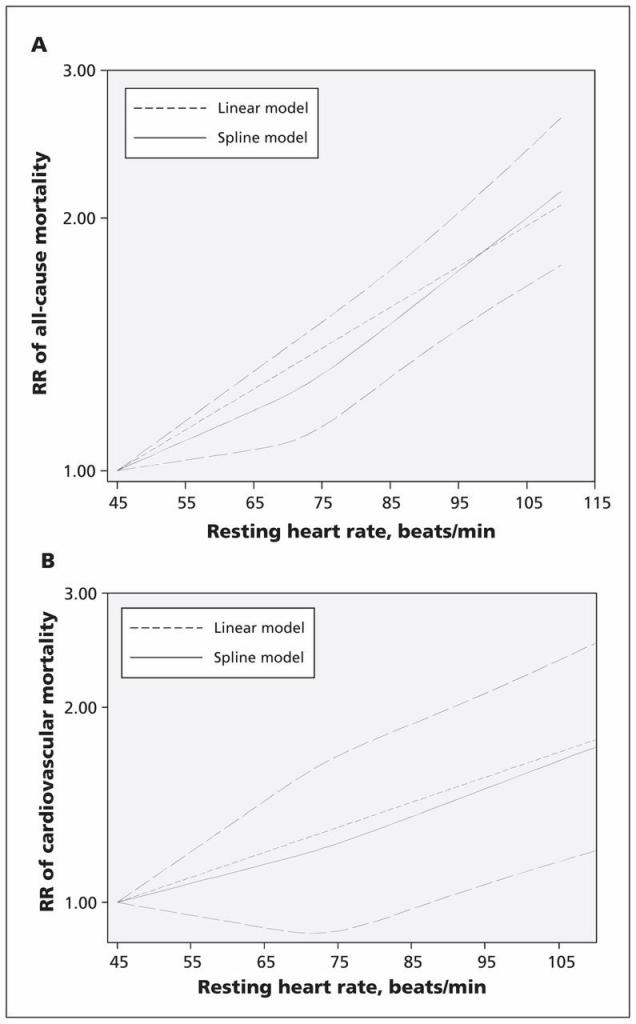
🫀 The Link Between RHR and All-Cause Mortality
📊 Ideal Resting Heart Rate Ranges:
• Athletes & Highly Fit Individuals: 40-60 bpm
• Healthy Adults: 60-80 bpm
• Potential Concern: 80+ bpm (especially if persistent)
⌚️ How to Measure Your RHR:
• Measure in the morning before getting out of bed.
• Use a wearable device or place two fingers on your wrist/neck.
• Count for 60 seconds or use a smart tracker for precision.
📉 What Your RHR Trends Can Tell You:
• Decreasing RHR?
Likely improved cardiovascular health.
• Increasing RHR?
Could signal stress, fatigue, or overtraining.
• Sudden spikes?
Possible illness or dehydration—time to assess recovery strategies.
🫀 How to Improve Your RHR in General
🚶♀️ Engage in regular aerobic exercise
😴 Prioritize quality sleep – your heart recovers best at night
🧘🏽 Manage stress with mindfulness and breathing exercises
🥗 Stay hydrated and fuel wisely – nutrient-rich foods support heart health
Tracking your RHR is a simple, data-driven way to optimize your longevity and performance. If you haven’t started yet, now is the time to tune in to your body’s most essential rhythm.
🔍 What’s Really Behind Your RHR? Let EON Find Out
We just learn that your movement, sleep quality, stress level, and diet are all connected together to your RHR.
But here’s the truth:
what’s actually holding back YOUR Resting Heart Rate (RHR)?
That answer is different for everyone.
For some, poor sleep quality is the main culprit – even if their cardio fitness is top-notch. Others may be under constant stress without realizing it. You might think you’re doing all the right things, but still see no improvement.
And that’s exactly where EON steps in.
💡 EON doesn’t just track your RHR. It reveals what’s driving it.
It connects the dots between your all metrics and routines acrossrecovery, nutrition, movement, stress, and even patterns from days before. You won’t have to guess. EON shows you.
⚠️ Notice a sudden spike in RHR that doesn’t settle in a few days?
It might not just be stress or fatigue.
It could be your body’s early warning sign – fighting off an illness before symptoms show up.Instead of pushing harder, that’s your cue to shift into recovery mode: better sleep, gentle movement, and hydration.With EON’s smart deviation notification, you’ll spot these spikes before they spiral. So you can stay ahead of burnout, not crash into it.
🔍 How to interpret EON Analysis – with Keon’s Real data
1. EON detects RHR spikes – and pinpoints the related factors.
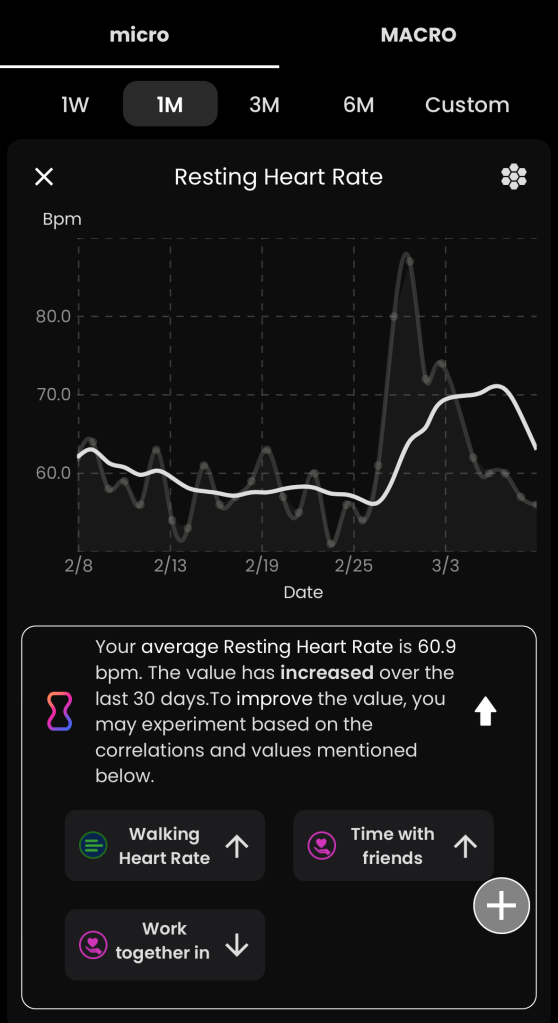
Here’s my RHR trend from Feb 8 to Mar 8. Notice the sudden spike from Feb 28 to Mar 3?
During that time, I was traveling to a high-altitude location with friends, dealing with disrupted sleep and a packed schedule in a low air pressure environment. EON flagged the spike and identified contributing factors – like reduced sleep duration and increased social time. 😂
Sure, the trip was refreshing for my mind, but my body needed more recovery than she realized. EON doesn’t just track the data – it connects it to your routines, behaviors, and context.
Back then, we didn’t yet factor in environmental variables like temperature, air pressure, or air quality. But since June 5, EON has leveled up.
Environmental conditions are now fully integrated into our analysis.
Whether it’s a heat wave, bad air quality, or a sudden drop in pressure, your body feels it – even if you don’t notice it yet. Now, EON does.
2. Your Body Doesn’t React Right Away. That’s Exactly Why EON Looks Deeper factors.
Our bodies often respond with a delay.
Food, for example, can affect you up to 48 hours later – making it hard to pinpoint which meal might be holding you back.
That’s why EON doesn’t just look at what happened today. It scans for patterns across the last few days to uncover what truly matters for you.
I used to think I could power through a bad night’s sleep. And I often did at least on Day 1. But it’s Day 2 when the real fatigue hits. EON offered a helpful clue about what my body may have been trying to tell me
With EON, those subtle delays become visible and finally, actionable.

Play with EON and take advantage of it as your augmented intelligence!
Stay tuned! 💙🚀
 Kyunivers
Leave a comment