

Image credit: East Cornwall Osteopathy@Pinteres
In our last episode, we covered the major releases from every major AI player—Google, OpenAI, Microsoft, and Anthropic—and shared EON’s teaser video powered by Google’s Veo.
At the end of that letter, I mentioned what was coming next: a deeper look into how those AI leaders are making moves in the health domain.
🎧 Podcasts generated by NotebookLM:
🎧 Listen to “AI Reshaping Health: Strategies, Tools, and Real-World Impact”
🎧 Listen to “AI의 건강 혁명: 주요 기업 전략과 미래”
Big Players’ Strategies for Accelerating Healthcare AI
Major AI players aren’t just building smarter chatbots or creative tools—they’re positioning themselves to transform medicine.
What stood out most?
Not just the tools, but the strategy.
By actively integrating physicians, these companies are creating real bridges between AI and the clinical world.
By doing so, they’re not just building tools—they’re building trust and access points for large-scale integration.
It reminds me of Tesla’s Full Self-Driving (FSD) approach.
Unlike legacy automakers who worked through consortia and regulatory frameworks, Tesla released a beta that consumers could opt into—letting the public experience the future early and giving the system real-world data to learn.
Likewise, by embedding doctors directly into these AI systems, tech companies aren’t trying to go around regulation—they’re accelerating acceptance. I believe this will let us experience the benefits of AI in health faster than anyone expects.
Beyond general AI capabilities, these same companies are investing deeply into health-specific AI applications:
OpenAI launched HealthBench,
A dataset built from 5,000 multi-turn doctor-patient conversations across 60 countries to benchmark model safety and medical reasoning.
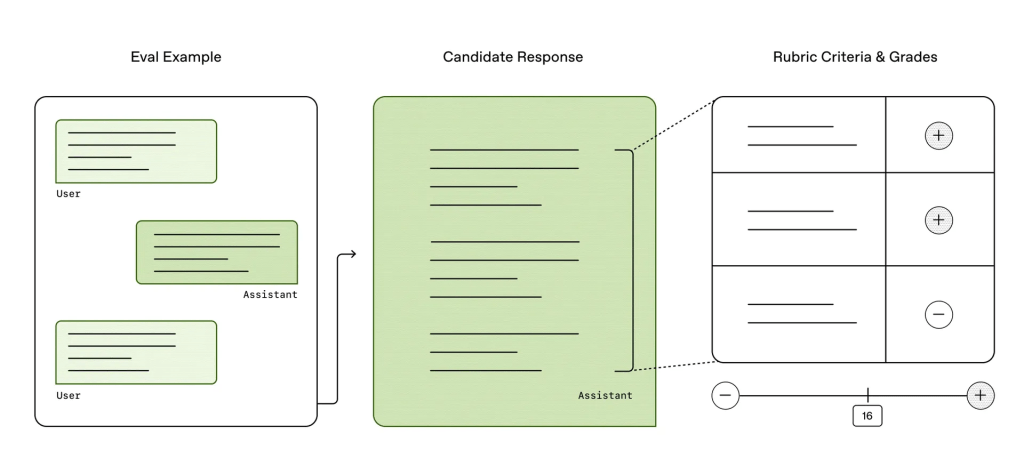
Some have questioned why we still need physician evaluations when AI models already outperform doctors on many benchmarks.
Personally, I find OpenAI’s approach meaningful.
A scientific safeguard, yes. But more importantly, involving doctors in the evaluation loop is a fulfillment of our social contract. It brings clinicians into the inner circle of algorithmic improvement, and serves as a cultural bridge to practical adoption.
Doctors may soon begin learning from AI—just as professional Go players did after AlphaGo shocked the world over a decade ago by making moves that defied human intuition.
Back then, those moves were unthinkable. Now, they are part of modern Go strategy.
In the same way, HealthBench could mark the start of physicians expanding their own mental models through exposure to AI-generated insight.
Google announced MedGemma
MedGemma is an open model for medical text and image comprehension, built on the Gemma 3 foundation.
It comes in two versions: a 4B multimodal model and a 27B text-only version.
Developers can fine-tune these models for specific health applications or integrate them with other AI agents in a broader orchestration system.
Google introduces example use cases like medical image classification, interpretation, text comprehension, and clinical reasoning.
But they also make clear that developers are free to pursue any application, as long as it complies with Health AI Developer Foundations terms of use. In other words, it’s an open invitation to accelerate real-world deployments.
What stands out to me is Google’s strategy here: make a capable, efficient model freely available—not to showcase a polished endpoint, but to accelerate the messy, valuable process of in-the-wild improvement.
Its small size makes MedGemma highly efficient for fine-tuning, and remarkably, its baseline performance on clinical reasoning tasks (as measured by MedQA) rivals much larger models.
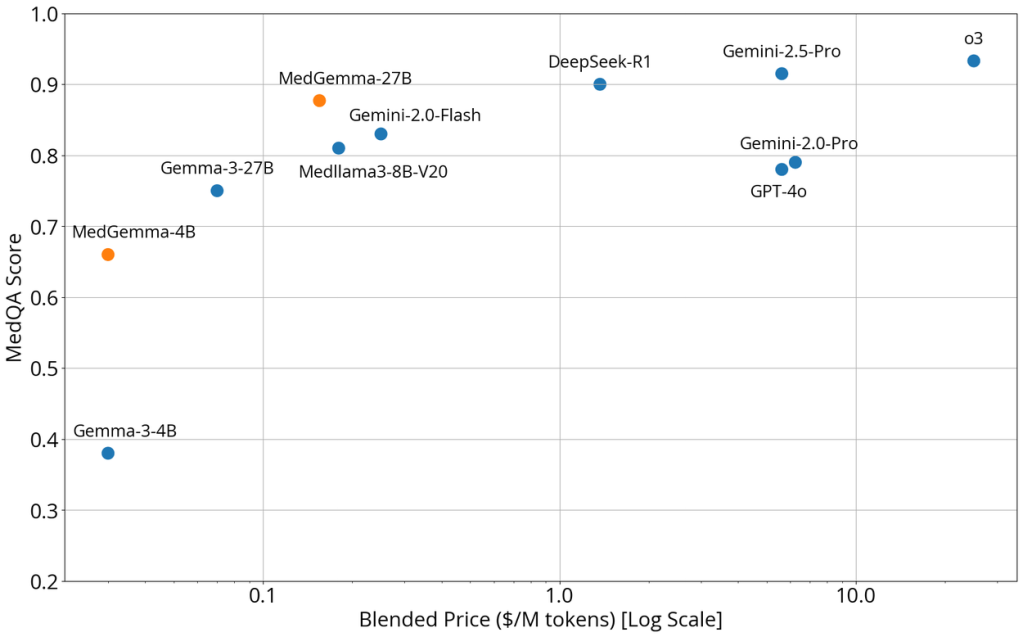
MedGemma’s baseline performance on clinical knowledge and reasoning tasks is similar to that of much larger models.
To me, this signals a clear priority:
get working models into the hands of builders and let deployment data close the last mile.
That’s how you shorten the time from innovation to impact.
Microsoft deployed its Healthcare Agent Orchestrator
Microsoft deployed its Healthcare Agent Orchestrator in collaboration with Stanford Health Care to reduce prep time for tumor boards.
As we explored in our last episode, Microsoft is leaning heavily into multi-agent orchestration—and it’s a strategy that plays to their strengths, already deeply embedded across large organizations.
Microsoft is now applying this approach to one of the most complex and high-impact areas in healthcare: multidisciplinary cancer care.
Top cancer centers rely heavily on tumor boards—dedicated, collaborative sessions where radiologists, pathologists, surgeons, oncologists, genetic counselors, and other specialists come together to align on personalized treatment plans. These meetings demand extensive preparation, deep specialization, and comprehensive data synthesis.
The result? Fewer than 1% of patients currently benefit from these high-touch decisions, even though outcomes are demonstrably better when they do.

By focusing their orchestration framework on this exact bottleneck, Microsoft is showing strategic precision.
From Expert Models to Everyday Value: Closing the Last Mile of Health AI
These releases mark the early chapters of a fundamental shift in how health will be practiced, protected, and personalized.
We explored the latest health-related releases and strategic moves by AI’s major players.
Just as Tesla’s approach to self-driving accelerated real-world usage and feedback, today’s AI leaders are each leveraging their strengths to push health applications closer to real-life adoption—from physician integration to enterprise orchestration.
You may feel, as I do,
that despite all these breakthroughs, much of this innovation still feels a bit distant from our daily lives.
At EON, we’re focused on closing that gap—translating expert AI model capabilities into everyday value for individuals.
We believe that by standing on the shoulders of giants, we can realize the last mile of AI-powered healthcare—one that meets people not in research labs or hospital systems, but in the rhythms of their own lives.
Stay tuned. We’re just getting started.
 Kyunivers
Leave a comment