
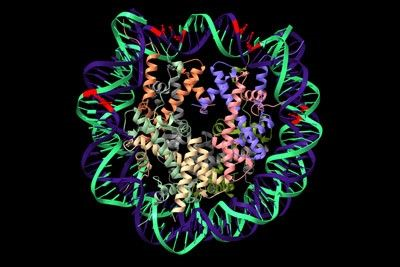
Last week, we revisited the past-stories and ideas from history.
This week, we step into the forefront of cutting-edge science where our understanding of life, health, and aging is being fundamentally redefined.
And if it’s been a while since you last studied biology, be ready: much of what you thought you knew might soon look very different.
[English]
[Korean]
—
Generate by NotebookLM
Is Destiny Written at Birth, or Rewritten Every Day by How We Live?

Gene Expression
Before we dive deeper, let’s briefly awaken some memories from school science classes. 👩🏻🏫
At the core of every cell, DNA holds the complete set of instructions for life. These instructions are copied into RNA, which acts as a messenger, carrying the information needed to build proteins—the essential components that structure, power, and regulate the body.
Epigenetics refers to changes in gene activity that do not alter the DNA sequence but influence how and when genes are turned on or off. It plays a key role in development, aging, and how the body responds to the environment.
The science of Epigenetics is still in its early stages,
we still know enough to bring meaningful changes in our aging biology and that’s what I am going to tell you about.
What Is Epigenome?
Although the concept of epigenetics was introduced in the 1940s, it wasn’t until the late 20th and early 21st centuries that scientists began to uncover its molecular mechanisms.
The breakthrough came when researchers discovered that chemical modifications—like DNA methylation where a small molecule attaches to DNA—could dramatically alter how genes are expressed without changing the DNA sequence itself.
The epigenome plays a crucial role in regulating gene expression, determining which genes are active or inactive.
Although all the cells in our body carry the same DNA, they differentiate into hundreds of distinct types, such as muscle cells, neurons, and liver cells.
Muscle cells and liver cells share identical DNA, yet they look, function, and even age very differently.
This diversity is made possible by the epigenome, which controls how the same genetic code is selectively used in different cells.
Imagine your DNA as an orchestra:

The genes are the instruments, and epigenome is the conductor that decides which instruments play, how loudly, and when.
These molecular “conductors” don’t alter the genetic code itself,
but they profoundly shape how the biological symphony plays out, moment by moment and year after year.
Aging and Epigenome
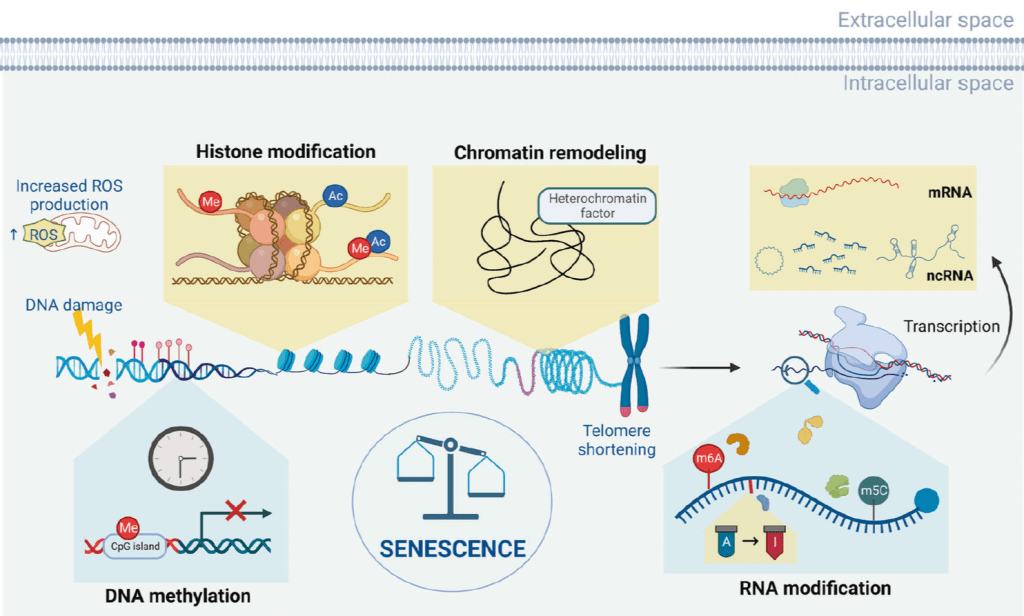
An overview of the aging epigenome.
During aging and the emergence of cellular senescence, a series of epigenetic changes occur in cells, including alterations in DNA methylation, chromatin remodeling, histone modification, RNA modification, and ncRNA regulation
Over time, the “conductor” can lose precision. The epigenome becomes increasingly dysregulated.
Cumulative damage from stress, poor nutrition, toxins, and chronic inflammation can disrupt epigenetic regulation, leading to:
• Cells may lose their original function and structure:
Liver genes are turned on in brain cells, and stomach genes in muscle cells where they don’t belong.
• Important protective genes may stop working: Critical protective genes that should stay active, like those involved in DNA repair, are turned off.
• Harmful processes may become overactive:
Pathways that trigger inflammation or other damaging responses are activated when they shouldn’t be.
Aging, in large part, is the story of losing epigenetic order.
The Weight of Experience Across Generations
Epigenetic changes don’t just affect the individual.
They can ripple across generations.
During the Dutch Hunger Winter of World War II, severe famine left molecular scars on children in the womb. Decades later, these individuals showed higher rates of metabolic disease and heart conditions.
The environments we live in today may help write not just our own biological story, but that of those who come after us.
Why This Changes Everything
Traditional medicine divided the world into two states:
healthy or sick.
But the realities of aging refuse to fit into that binary. Most chronic conditions are not sudden failures; they are slow transformations that accumulate over time.
Understanding, measuring, and influencing epigenetic changes opens a powerful new strategy:
one that doesn’t just treat symptoms,
but seeks to preserve and even extend human functionality itself.
Where We’re Headed
In the coming issues, we’ll explore:
• The evolving landscape of epigenetic regulation in Aging Research
• What it might truly mean to intervene in aging
• Practical, science-backed ways you can start influencing your biological future today
The future of aging is no longer passive.
It is an active pursuit that may shape not only how long we live, but how well we live.
Stay with me!
 Kyunivers
Leave a comment